
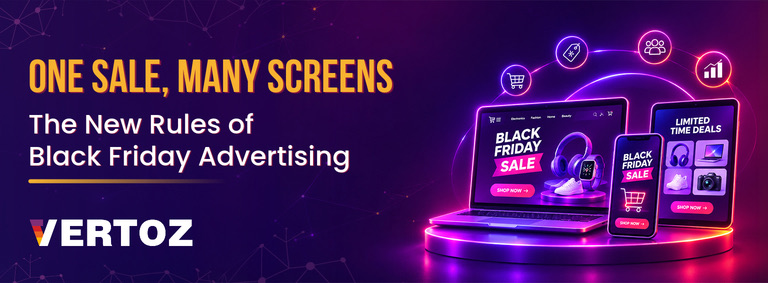
Black Friday shoppers rarely buy after seeing just one ad. They might spot a deal while streaming a show, compare prices on their phone and then complete the purchase later on a laptop. The challenge for advertisers is keeping those interactions connected without blowing the budget.
A strong Black Friday advertising strategy brings audience targeting, creative messaging, media buying and campaign measurement together across channels. Being on more screens isn’t the goal in itself. The aim is to reach potential customers at the right moment and turn that attention into measurable sales.
Table of contents:
- Why Black Friday Advertising Requires More Than One Screen
- Building a Black Friday Advertising Strategy Around Customer Intent
- How Programmatic Advertising Connects the Shopping Journey
- How to Turn Black Friday Media Spend into Measurable Results
- Frequently Asked Questions
- Conclusion: Every Screen Counts
Why Black Friday Advertising Requires More Than One Screen
Black Friday is no longer a one-day shopping event. Promotions often begin weeks ahead, which gives consumers more time to research products, compare offers and decide where to spend.
That creates an interesting challenge for marketers. Someone who watches a product ad on Connected TV (CTV) may not buy straight away. The same person might search for reviews the next morning, or respond to a retail media ad closer to checkout.
A good cross-channel advertising strategy recognizes these different stages and doesn’t treat every impression as an immediate chance to convert.
IAB Europe’s Attitudes to Retail Media Report 2025 (opens in a new tab) points to growing investment in off-site retail media, driven by display and social formats. It also names a lack of standardization and the fragmentation of retail media networks as barriers advertisers still face.
The implication is clear: more media reach is only useful when marketers understand how each channel contributes to the purchase journey.
Building a Black Friday Advertising Strategy Around Customer Intent
The starting point should be what customers are trying to accomplish, not how many advertising formats to buy.
A shopper researching a new television needs different information from someone who has already added one to their cart. Sending both the same discount message ignores where each of them is in the purchase.
A practical way to handle this is to organize campaigns in four phases:
- DiscoverUse first-party data, contextual signals and audience insights to understand audience needs, shopping behavior and purchase intent.
- ExploreUse CTV and video, digital out-of-home (DOOH), programmatic display and paid social to show products, highlight upcoming promotions and reach relevant audiences.
- ConvertUse search, retail media and retargeting to reach high-intent shoppers with relevant product messages close to the purchase decision.
- OptimizeAssess campaign performance as it runs and adjust audience targeting, messaging and media spend accordingly.
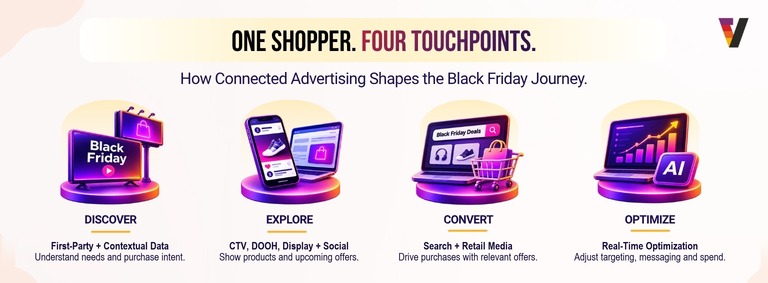
These touchpoints don’t have to happen in a fixed order. The goal is a consistent message that still lets customers move naturally between screens.
First-party audience data, contextual signals and behavior-based segmentation can all support this, as long as they are collected and activated with appropriate privacy safeguards.
How Programmatic Advertising Connects the Shopping Journey
Programmatic advertising lets marketers buy media and manage ad placements automatically, instead of negotiating each placement one by one. During Black Friday, that matters because the peak weeks don’t stand still.
With real-time bidding (RTB), each eligible ad impression is evaluated as it becomes available. The buying platform checks it against the campaign’s rules, such as audience, context, placement and budget, uses the signals available to decide whether it’s worth buying, and bids accordingly. Results then feed back into the next decisions.
This is especially helpful in busy shopping periods, when audience behavior, inventory availability and media costs can all change quickly. Prices for the same audience can rise as more advertisers compete for it, and inventory that was easy to buy a week earlier may be harder to win on the day.
For example, an electronics retailer could use video ads to build awareness, display ads to stay top of mind and commerce placements to reach people comparing prices.
The benefit is flexibility. Campaigns can respond to performance signals without every change being made by hand. IngeniousPlex, the performance-focused media buying platform within the Vertoz ecosystem, gives advertisers and media buyers control over targeting, bids and budgets, with source-level reporting that shows which traffic sources and placements are contributing to results.
But automation doesn’t guarantee efficiency. Poor audience segmentation, too much frequency or unclear measurement can still drive up customer acquisition cost. As Vertoz’s article on signs your programmatic strategy is outdated explains, better data practices, timely optimization and more meaningful measurement are what improve campaign performance.
How to Turn Black Friday Media Spend into Measurable Results
A campaign can have great reach and still fail to generate profitable sales.
That’s why optimizing Black Friday ad campaigns should be about business outcomes, not just impressions or clicks. Four priorities make the difference:
- Control frequency. Limit unnecessary repeat exposure where cross-channel measurement and inventory controls allow it. Frequency capping sets how often the same person sees an ad.
- Adapt creative messaging. Use dynamic creative optimization to match products and promotions to what each audience needs at that stage.
- Track acquisition economics. Compare customer acquisition cost (CAC), conversion rate and return on ad spend (ROAS) with revenue and profit margins.
- Reallocate budgets on evidence. Don’t move money because something is getting a lot of clicks today. Move it because there’s evidence it performs well over time.
AI-powered Black Friday advertising can help here too. AI-assisted optimization can spot patterns sooner and support faster decisions on bids, targeting or budgets. It still needs clear objectives, the right data, sound measurement and human oversight to point it at the right result.
Measurement Deserves Special Attention
Last-click attribution gives all the credit to the final interaction and ignores the earlier touchpoints that helped drive the purchase. A single Black Friday sale can involve a path like this:
CTV → Search → Display and retargeting → Retail media → Purchase
The IAB/MRC Retail Media Measurement Guidelines (opens in a new tab) describe assisted, or halo, outcomes: ad interactions that may have helped drive a sale even though they don’t receive explicit attribution credit. Looking at them gives a fuller view of the customer journey and of which interactions contribute to sales.
Not every exposure can be connected to a sale, so treat any cross-channel view as an estimate and be clear about how it was built. Vertoz’s approach to measurement and accountability reports against the outcome agreed at the start. Likewise, Vertoz’s post on attention metrics vs. viewability explains why a technically viewable ad shouldn’t be mistaken for meaningful engagement.
Frequently Asked Questions
1. What matters most in a Black Friday advertising strategy?
Lining up channels, messages and campaign goals with what shoppers are trying to do at each stage, and then measuring actual business results such as sales and profit rather than reach alone.
2. Why is programmatic advertising useful during Black Friday?
Audience behavior, inventory availability and media costs change quickly in the peak weeks. Programmatic buying evaluates eligible impressions automatically against your campaign rules, so targeting, bids and budgets can be adjusted as conditions change instead of being renegotiated placement by placement. Results still depend on good segmentation, sensible frequency and clear measurement.
3. Does CTV advertising drive Black Friday sales?
CTV is strong for product discovery and consideration before the sale starts. Its effect on sales is usually indirect, so judge it by what happens after exposure, such as branded searches, site visits and later purchases, rather than by last-click conversions alone.
4. How can advertisers avoid wasting Black Friday ad spend?
Control frequency, test creative variations, track acquisition cost against margin and refine targeting as evidence comes in. Avoid moving budget on the strength of a single day’s clicks.
5. Which metrics matter most for Black Friday campaigns?
ROAS is a useful starting point, but customer acquisition cost, conversion rate, profitability and incremental sales show whether the campaign made money and whether those sales would have happened anyway.
6. When should advertisers start Black Friday campaigns?
Before the promotions go live. Because Black Friday offers now often begin weeks ahead of the day itself, discovery and consideration activity needs time to build interest before conversion-focused activity peaks.
Conclusion: Every Screen Counts
The best Black Friday advertising comes from knowing what each channel should be doing and measuring every investment against real results.
Rather than chasing impressions across disconnected platforms, marketers should build campaigns around customer intent, coordinated execution and continuous measurement.
Vertoz, an AI-led advertising ecosystem engineered for outcomes, offers managed media execution that helps brands coordinate advertising across channels while keeping control of campaign delivery, pacing and optimization.