



A bigger budget will almost always buy more clicks. The hard part is turning those clicks into paying customers at a cost the business can sustain.
If your campaigns bring in traffic but acquisition costs keep climbing, cutting the budget rarely fixes it. The more reliable way to reduce customer acquisition cost is to improve the system that turns spend into customers, from who you target to what those customers are worth once they arrive.
This guide walks through that system step by step. The aim is to get more customer value from the money you already spend, rather than simply spending less.
Table of contents:
What Is Customer Acquisition Cost and Why Does It Matter?
Customer acquisition cost (CAC) is what it costs, on average, to win one new paying customer. It shows whether your acquisition efforts make financial sense once every relevant cost is counted.
CAC = Total customer acquisition expenses ÷ Number of new customers acquired
Expenses usually include ad spend plus related sales and marketing costs, such as agency fees, tools and creative production. Whatever you include, keep it consistent so CAC can be compared month to month.
Say you spent $10,000 on acquisition-related marketing and sales activity in a month and won 200 new customers. Your CAC for that month is $50.
CAC and CPA Are Related, but Not the Same
Cost per acquisition (CPA) measures the cost of a defined conversion, such as a lead, a sign-up, an app install or a purchase. CAC measures the cost of acquiring an actual new customer, and it usually takes in a wider set of costs.
For example, a campaign might deliver leads at a $20 CPA. If one in ten of those leads becomes a customer, the media cost alone is $200 per new customer, and CAC is higher again once sales costs are added.
So a campaign can look efficient on CPA and still be expensive on CAC. And a lower CAC only helps if the customers you win are good ones. Cheap customers who leave after one order don’t do much for profitability.
How to Reduce Customer Acquisition Cost in Paid Advertising
Most CAC problems come from five places, summarized below. They build on each other: better audiences make conversion easier, and better conversion data makes bidding smarter.
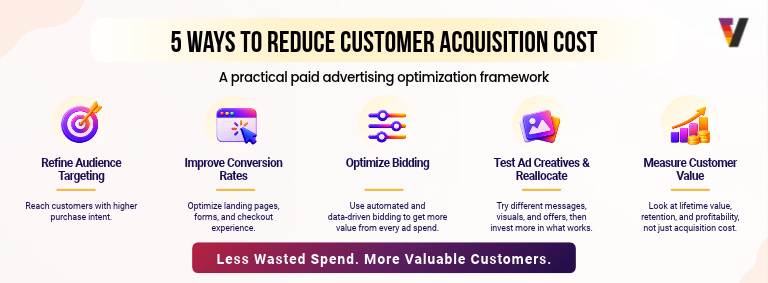
1. Refine Audience Targeting to Reduce Wasted Spend
Reaching more people doesn’t automatically bring in more customers. Broad targeting often buys plenty of impressions from people with little reason to buy.
Start by finding the segments that produce qualified leads and actual purchases, not just clicks. Compare results by geography, device, buying intent and past interaction with your brand to see where the budget works hardest.
Then tighten the targeting with first-party customer data, contextual targeting and sensible exclusions, such as existing customers in an acquisition campaign. In programmatic campaigns, look at placement quality as well as audience fit. Low-quality or fraudulent inventory can make a campaign look busy without adding customers, which is why brand safety and fraud controls belong in any CAC review.
Vertoz’s guide to effective audience targeting with programmatic advertising goes further into building and refining segments.
2. Improve Conversion Rates Before Increasing Budgets
Sometimes the ads aren’t the problem. The landing page is.
If people click an ad and leave without doing anything, you’ve paid for the visit and got nothing back, so acquisition cost rises even when traffic holds steady. Conversion rate optimization usually deserves attention before any budget increase. Focus on:
- Landing page relevance: the headline and offer should match the ad that brought the visitor there.
- Page experience: fast loading and easy use on mobile.
- Conversion process: remove form fields and checkout steps that don’t need to be there.
- Calls to action: make the next step obvious.
Take a campaign that buys 1,000 clicks at $2 each, a media cost of $2,000. At a 2% conversion rate to new customers, that’s 20 customers and a media cost of $100 per customer. Lift the conversion rate to 4% and the same $2,000 brings in 40 customers, so the media cost per customer falls to $50 without any change to the budget.
This is an illustrative calculation. It counts media cost only, not the other expenses that go into CAC.
3. Use Smarter Bidding and Campaign Optimization
Not every impression is worth the same bid. Someone who has just compared prices on your site is worth more to you than someone who landed on a page by accident.
Automated bidding adjusts bids using audience signals, campaign goals and the predicted likelihood of conversion. Google’s Target CPA bidding (opens in a new tab), for example, aims for as many conversions as possible at or below the average cost per action you set. Set the target too low, though, and you may get fewer conversions. Remember too that the “action” is whatever conversion you defined, so a CPA target isn’t a CAC target.
In programmatic advertising, the platform you buy through decides how much you can see and control. IngeniousPlex, the performance-focused media buying platform within the Vertoz ecosystem, gives advertisers and media buyers source-level reporting and control over targeting, bids and budgets, so it’s easier to see which sources bring in customers and which only bring activity. Deciding what to scale or cut still sits with the team running the campaign.
Automation can’t replace measurement, either. If conversion tracking counts the wrong action, the system will still optimize, just toward conversions with little commercial value.
4. Test Ad Creatives and Reallocate Budgets
An ad that worked well at launch usually loses some of its pull once people have seen it several times.
Regular creative testing shows which messages, visuals, formats and offers bring in customers. Change one significant variable at a time so you know what caused the difference.
Look past click-through rate. A creative that wins clicks from the wrong people can push CAC up, so compare customer conversions, acquisition cost and customer quality before calling a winner. Vertoz’s guide to maximizing ad spend efficiency covers how testing and data-driven optimization help put budget where it performs.
Then move budget toward the campaigns and creatives that perform consistently. Just don’t make that call on a handful of conversions or a few days of data, because small samples can make an average ad look like a winner.
5. Measure Customer Value, Not Just Acquisition Cost
The cheapest customer isn’t always the most profitable one.
A campaign that acquires customers at $30 each can be a better investment than one that acquires them at $15, if the $30 customers stay longer and spend more. Judge CAC against margin, retention and customer lifetime value (CLV), which is the revenue or profit a customer is expected to bring over the whole relationship.
Break results down by audience segment and acquisition channel instead of relying on account-wide averages. An average can hide a channel that brings in loyal customers behind one that brings in one-time buyers. Consistent measurement and attribution keeps those comparisons fair.
Common CAC Optimization Mistakes to Avoid
Cutting acquisition costs without thinking through the consequences can create bigger problems. Watch for these:
- Optimizing for lead volume and paying for leads that never become customers.
- Pausing campaigns before they’ve collected enough conversion data.
- Ignoring retention and customer lifetime value.
- Scaling budgets without checking whether conversion quality holds up.
- Comparing acquisition costs across channels that use different attribution settings.
Frequently Asked Questions
1. What is a good customer acquisition cost?
There’s no universal benchmark. It depends on your industry, margins, customer lifetime value and business model. The useful test is whether customers bring in comfortably more profit over time than they cost to acquire.
2. Can retargeting reduce customer acquisition cost?
It can, because it reaches people who have already shown interest. Some of them would have bought anyway, though, so judge its contribution with sound attribution and, where possible, incrementality testing.
3. Does a higher conversion rate reduce CAC?
Generally, yes, as long as acquisition spend stays the same and the extra conversions are genuinely new customers.
4. How often should paid campaigns be optimized?
Monitor performance regularly, but make major changes only when enough reliable data supports them. Frequent large changes can also send automated bidding back into a learning period.
5. Is CPA the same as CAC?
No. CPA measures the cost of a defined conversion, such as a lead or a sign-up. CAC measures the overall cost of acquiring a new paying customer.
6. How can paid advertising reduce customer acquisition cost?
By winning more new customers from the same budget, through tighter targeting, better-converting landing pages, bidding on reliable conversion data and shifting budget toward what brings in valuable customers.
Conclusion
Reducing customer acquisition cost takes more than lowering advertising budgets. It comes from finding valuable audiences, improving the conversion experience, bidding on reliable data, testing creatives and measuring what each campaign contributes to the business.
Start by finding where your acquisition funnel loses money, then fix those areas one at a time. With disciplined measurement, paid advertising optimization can improve acquisition efficiency without sacrificing customer quality or long-term growth.