


For over a decade, viewability has been the undisputed benchmark in digital advertising. The rule was simple: if at least 50% of an ad’s pixels appeared on a user’s screen for one second (or two seconds for video), it was counted as “seen.” This standard, set by the Interactive Advertising Bureau (IAB), became the foundation for billing, reporting, and campaign success. But here’s the reality check: just because an ad loads doesn’t mean anyone actually notices it.
Imagine this. A user opens a news article and scrolls rapidly to find a specific section. A banner ad at the bottom of the page briefly crosses the screen for 1.1 seconds. Technically, it’s viewable. The publisher gets credit. The advertiser gets charged. The report looks great. But did the message land? Did it spark interest? Did it influence a purchase decision? In nearly every case, the answer is no. This is the core flaw in the viewability model: it measures opportunity, not impact.
As brands pour billions into digital campaigns, they’re waking up to a harsh truth. High viewability scores don’t guarantee results. In fact, global viewability rates have climbed steadily over the years, yet actual user engagement per ad has declined. We’ve built a system that rewards technical visibility while ignoring human attention. And that’s where attention metrics come in, offering a smarter, more meaningful way to measure what truly works.
Viewability was designed to bring transparency to an opaque ecosystem. Before its adoption, advertisers had no way of knowing if their ads were even loading. It solved a real problem. But over time, it became a crutch, not a solution.
Consider these common scenarios:
These moments inflate performance reports but deliver zero real-world value. A 2024 study found that attention metrics predict campaign outcomes three times better than viewability alone. Yet many advertisers continue to optimize for the wrong signal. The result? Wasted budgets, frustrated users, and diminished brand trust.
Even worse, the chase for viewability has reshaped the internet itself. Publishers under pressure to hit viewability targets often prioritize ad density over user experience. Websites become cluttered with pop-ups, interstitials, auto-refreshing units, and video ads that play unmuted. These tactics technically meet viewability thresholds, but they train users to tune out ads entirely. The irony? The harder we try to be “seen,” the more invisible we become.
Why Attention Metrics Represent the Future?
Attention metrics don’t just ask, “Was the ad on screen?” They ask deeper, more meaningful questions:
Was it actually looked at? Did it hold focus? Did it resonate?
Unlike viewability’s binary pass/fail system, attention measurement evaluates the quality of exposure. It considers multiple signals:
These factors paint a complete picture of genuine engagement. And the data backs it up. Campaigns optimized using attention metrics see higher brand recall, better conversion rates, and stronger ROI.
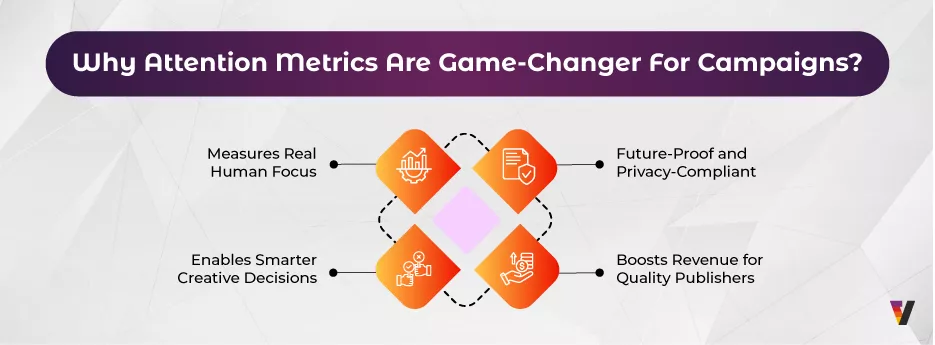
Here are four powerful reasons attention is replacing viewability as the gold standard:
How AI Powers the Attention Revolution?
Shifting to attention-based measurement isn’t just a mindset change. It requires advanced technology. This is where AI-powered platforms like Vertoz play a pivotal role.
Vertoz’s MadTech ecosystem uses machine learning to analyze billions of engagement signals in real time. It doesn’t just report that an ad was viewable. It reveals how much attention it earned, which creative elements worked, and which placements drove impact. For advertisers, this means data-driven optimization. For publishers, it means proving the true value of their inventory.
With Vertoz, brands move from guessing to knowing. They stop paying for ghosts in the machine and start investing in moments that matter.
Conclusion: From Visibility to Value
The future of digital advertising isn’t about buying space that might be seen.
It’s about creating messages that cannot be ignored.
Viewability was a necessary step. Attention is the destination.
In a world drowning in content, human attention is the scarcest resource. Advertisers who continue optimizing for viewability will keep chasing impressions that exist only on spreadsheets. Those who embrace attention will build campaigns that live in memory, spark action, and deliver lasting results.