


More impressions do not automatically produce better results. Once a person has seen the same ad several times, each additional exposure tends to add less, and at some point it can start to work against the campaign through lost attention, wasted budget, or irritation with the brand.
Ad frequency capping is how advertisers manage that balance. By limiting how often the same person sees an ad within a defined period, it helps campaigns keep brand visibility, protect the audience experience, use media budgets efficiently, and stay focused on the outcomes that matter.
Table of contents:
- What Is Frequency Capping?
- Why More Ads Don’t Always Mean Better Performance
- What Is a Good Ad Frequency?
- How to Calculate Ad Frequency
- How to Improve Campaign Performance With Frequency Capping
- Platform-Specific Frequency Controls
- Cross-Channel Frequency Management
- Every Impression Should Have a Purpose
- Frequently Asked Questions
What Is Frequency Capping?
Frequency capping limits the number of times a single person is shown an ad over a given period, whether a day, a week, or a month. It lets advertisers manage repeat exposure within eligible placements and campaigns, to the extent the advertising platform and its tracking capabilities allow.
Two related terms are worth separating:
- Ad frequency is the average number of times an individual in the reached audience is exposed to an advertisement during a defined period.
- A frequency cap is a configured limit on eligible ad exposure within a defined period, subject to platform capabilities and identity or measurement limitations.
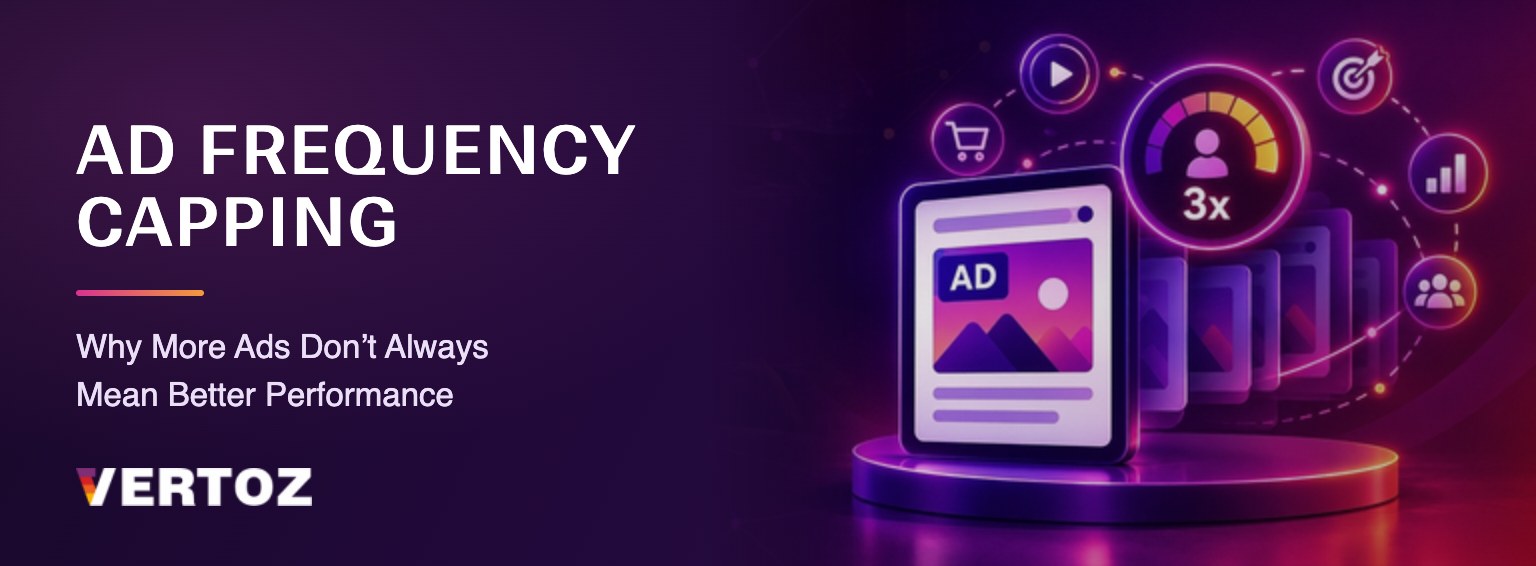
For example, if you cap impressions at three per user per day, the system will try to avoid showing the same eligible ad to that user more than three times that day. Three is used here only as an illustration; it is not a universal best practice, and the right cap depends on the campaign.
Without a cap, delivery can keep concentrating impressions on people who have already seen your message many times, while other potential customers see it rarely or not at all.
Why More Ads Don’t Always Mean Better Performance
Repeated exposure can build familiarity, and some repetition is often necessary for a message to register. Beyond a certain point, however, returns diminish: people begin to ignore a creative they have seen too often, stop engaging with it, or form a negative impression of the brand. Three effects are most common.
Ad fatigue
Audiences pay less attention to advertising they have seen repeatedly, which can reduce engagement and click-through rates. Our article on ad fatigue covers the warning signs in more detail.
Wasted media spend
Budget spent on additional impressions for people who are already saturated may deliver little incremental benefit, money that could have reached new or more responsive audiences.
Negative brand experience
Constant interruptions can be irritating and make a brand seem intrusive rather than relevant, which can undermine the very awareness or consideration the campaign set out to build.
Frequency management becomes more important as campaigns span websites, mobile apps, online video, and connected TV. A cap that works for one placement does not, on its own, control exposure across an entire media plan.
What Is a Good Ad Frequency?
There is no single right frequency. A sensible level depends on the campaign objective, how familiar the audience already is with the brand, creative quality, the length of the buying cycle, and the ad format. The table below sets out a starting approach for common objectives.
| Campaign Objective | Frequency Approach | Metrics to Monitor |
|---|---|---|
| Brand Awareness | Test controlled repeat exposure | Reach, frequency, brand recall |
| Website Retargeting | Limit repetitive reminders | Conversions, conversion rate, complaints |
| Lead Generation | Test frequency against lead quality | CPL, lead quality |
| E-commerce Sales | Align frequency with purchase intent | ROAS, CPA, incremental conversions |
| CTV & Video | Manage repeated exposure | Reach, completion rate, engagement |
These are planning approaches, not fixed industry benchmarks. Test different caps against your own campaign data to find what works for your audience and objective, rather than applying one cap to every campaign.
How to Calculate Ad Frequency
The standard formula is:
Average Ad Frequency = Total Impressions ÷ Unique Reach
Example: 100,000 impressions ÷ 25,000 unique people = 4 average impressions per reached person.
This is an average. It does not mean every person saw the ad exactly four times: some will have seen it once, others many more times. Looking at how exposure is distributed, where your reporting allows it, tells you more than the average alone.
Set Goal-Based Caps
Align exposure limits with campaign objectives and audience behavior.
Rotate Creatives
Refresh messages and visuals to maintain relevance.
Use Audience Signals
Segment audiences and exclude converted users where appropriate.
Measure Outcomes
Evaluate CTR, CPA, ROAS, and incremental reach.
How to Improve Campaign Performance With Frequency Capping
An effective approach combines campaign objectives, audience signals, creative rotation, and performance measurement.
Step 1: Set caps based on campaign goals
Avoid using one frequency cap for every campaign. An awareness campaign may need more repeated exposure to build recognition, while a retargeting campaign should not overwhelm people who have already visited your website. Lead generation and conversion campaigns sit somewhere in between and benefit from testing frequency against lead quality or cost per acquisition.
Decide what the campaign needs to achieve, then choose a starting cap you can justify with performance data and adjust as results come in.
Step 2: Rotate creatives
Frequency management is not only about limiting impressions; it is also about changing what people see. Rotating messages, formats, product recommendations, offers, and calls to action keeps a campaign relevant for longer. If people see the identical ad throughout a long campaign, even a reasonable cap may not prevent fatigue. Creative testing helps identify which variations hold attention.
Step 3: Use audience and conversion signals
Segment audiences by recent activity, refine retargeting accordingly, and exclude people who have already converted from acquisition campaigns where appropriate. For example, a retailer running seasonal offers might show different messages to first-time visitors, people who viewed a product, and recent customers, rather than the same ad to everyone.
These approaches depend on the identity signals available and must respect user consent and applicable privacy requirements.
Step 4: Measure business outcomes
A high frequency figure alone does not prove that a campaign is underperforming. Review frequency alongside click-through rate, conversion rate, cost per acquisition (CPA), return on ad spend (ROAS), incremental reach, and the other outcomes your campaign is accountable for.
If frequency is rising while performance falls, test a lower cap, refresh the creative, or move budget toward new audiences. Treat caps as hypotheses to test rather than fixed rules.
Platform-Specific Frequency Controls
Frequency controls differ by platform, campaign type, buying method, identity availability, and measurement capabilities. Not every campaign supports a configurable hard cap, so check the options in each platform before planning around one.
Google Ads
Frequency caps are available in Display and Video campaigns. In Display campaigns they can be set at campaign, ad group, or ad level, and only viewable impressions count toward the cap. In Video campaigns they are set at campaign level, on impressions, views, or both. Google states that Demand Gen campaigns do not support frequency caps, and other campaign types manage exposure differently.
Meta (Facebook and Instagram)
With reach and frequency buying, a reservation buying type available to eligible accounts, advertisers can set a frequency cap such as a maximum number of impressions per person over a number of days. In auction buying, the available controls depend on the objective, and many performance objectives optimize delivery without a fixed cap, so frequency is monitored in reporting and managed through audience, creative, and budget choices.
Programmatic advertising
In programmatic buying, demand-side platforms typically let buyers set caps at campaign, insertion order, line item, or creative level. Whether a cap is counted per user, device, browser, or household depends on the platform and the identity signals available; where those signals are limited, frequency counting is less precise.
When planning a capping approach, decide what the cap applies to: a single creative, a campaign, or a group of campaigns.
Cross-Channel Frequency Management
Managing frequency across several platforms is more complex, because platforms often do not share a common user identifier. The same person may be counted separately by a social platform, a video service, and a programmatic buy, so their combined exposure can be higher than any single platform reports.
It helps to distinguish three levels:
- Platform-level frequency capping: limits set within one platform, applied to the delivery that platform controls.
- Campaign-level frequency management: agreed rules across the campaigns in a media plan, such as which audiences each channel targets and how creative is sequenced.
- Cross-channel exposure measurement: estimating combined reach and frequency across channels, which depends on the identity and measurement signals available and is rarely complete.
Complete deduplication across every channel is often not possible. In practice, advertisers combine platform caps with coordinated planning and outcome-based measurement. A managed media execution approach can help coordinate campaigns across channels and keep frequency decisions tied to the results each channel is expected to deliver.
Every Impression Should Have a Purpose
Campaign success is not determined by impression volume alone. Effective frequency management balances reach, relevance, audience experience, advertising investment, and measurable outcomes.
Review how often your audiences are seeing your ads, identify segments with heavy repeat exposure, and test alternative caps alongside creative rotation. As an AI-led advertising ecosystem engineered for outcomes, Vertoz approaches media buying with the same principle: impressions are a means to an outcome, not the goal in themselves.
Frequently Asked Questions
1. What is ad frequency?
Ad frequency is the average number of times a person in your reached audience sees an ad during a defined period, such as a day, a week, or the length of a campaign. It is calculated as total impressions divided by unique reach.
2. What is a good frequency for an ad?
There is no single right number. A good frequency depends on your campaign objective, audience, creative, buying cycle, and format. Start with a cap you can justify, test alternatives, and refine it using conversion, reach, and cost data from your own campaigns.
3. What is a Facebook ad frequency cap?
In Meta advertising, a frequency cap is a limit on how many times a person can be shown your ad within a set period. It can be set with reach and frequency buying, a reservation buying type available to eligible accounts. Many auction campaigns optimize delivery without a fixed cap, so frequency is monitored in reporting and managed through audience, creative, and budget decisions.
4. Can frequency capping work across multiple advertising channels?
Partly. Each platform can usually cap its own delivery, but platforms rarely share a common user identifier, so complete deduplication across channels is often not possible. Teams typically combine platform-level caps, coordinated campaign rules, and cross-channel reach and frequency measurement where the available identity and measurement signals allow it.
5. Does frequency capping improve ROAS?
It can help by reducing spend on impressions that add little value, but it does not guarantee a higher return on ad spend. Measure conversions, cost per acquisition, and incremental performance to see whether a cap is improving results for your campaign.